
Why Every “5% Flat Tax” Headline Is Lying to You
If you’ve read even one article about Italy’s digital nomad visa, you’ve seen the magic number: 5% flat tax. It sounds almost too good to be true. And that’s because it is, if you stop reading after the headline.
You need to know about INPS Contributi, and how it impacts your decision, lifestyle, and life plans.
What nobody tells you is that the 5% figure only covers income tax. The real financial gut-punch comes from INPS Contributi, Italy’s national social security institute, which charges self-employed digital nomads 26.07% of their taxable income. That is not a typo. Twenty-six point zero seven percent.
This article is the guide nobody else has written. We’re going to walk through exactly what INPS Contributi are, how they’re calculated, how they interact with Italy’s tax regimes, what they mean for your take-home pay, and, crucially, how to legally minimize them. By the end, you’ll know whether Italy is actually a financial win for your situation, or whether the “5% tax” headline is a mathematical trap.
What Is INPS Gestione Separata?
INPS stands for Istituto Nazionale della Previdenza Sociale, Italy’s National Social Security Institute. It manages pensions, healthcare access, unemployment benefits, maternity/paternity leave, and disability coverage for all workers in Italy.
For self-employed digital nomads who don’t belong to a regulated profession (like lawyers, doctors, or engineers who have their own private pension funds), INPS operates a catch-all regime called Gestione Separata, the “Separate Management Fund.” It was created in 1996 specifically to cover atypical workers who didn’t fit into traditional employee or artisan categories.
Think of it as Italy’s equivalent of the US self-employment tax or the UK’s Class 2 and Class 4 National Insurance contributions. But unlike the US, where self-employment tax is 15.3%, Italy’s rate is 26.07% for VAT-registered professionals enrolled exclusively in Gestione Separata.
Here’s the breakdown of the 2026 rates, confirmed by INPS Contributi Circular No. 8/2026:
| Category | 2026 Rate |
|---|---|
| Self-employed professionals with VAT number (no other pension coverage) | 26.07% |
| Self-employed with other mandatory pension coverage or retirees | 24.00% |
| Coordinated collaborators (co.co.co.) with DIS-COLL | 35.03% |
| Coordinated collaborators without DIS-COLL | 33.72% |
The 26.07% rate applies to net taxable income, not gross revenue. For digital nomads under the Regime Forfettario, that means your taxable base is your gross revenue multiplied by your ATECO profitability coefficient (typically 78% for professional services).
The Math That Changes Everything
Let’s run the numbers for a typical digital nomad earning €40,000 gross per year from foreign clients, operating under the Regime Forfettario in their first five years in Italy.
Step 1: Calculate taxable income
- Gross revenue: €40,000
- ATECO coefficient (professional services): 78%
- Deemed taxable base: €40,000 × 0.78 = €31,200
Step 2: Calculate income tax
- Tax rate (Regime Forfettario, years 1–5): 5%
- Income tax: €31,200 × 0.05 = €1,560
Step 3: Calculate INPS contributions
- INPS rate: 26.07%
- INPS contributions: €31,200 × 0.2607 = €8,134
Step 4: Total tax burden
- Income tax + INPS: €1,560 + €8,134 = €9,694
- Effective tax rate on gross revenue: €9,694 / €40,000 = 24.2%
Step 5: Take-home pay
- €40,000 – €9,694 = €30,306
Look at that again. The headline says “5% tax.” The reality is 24.2% of your gross revenue disappears into Italian tax and social security. INPS Contributi alone costs you €8,134, more than five times your income tax bill. This is the number that should be in every article about Italy’s digital nomad visa. It almost never is.
The Ceiling Effect: When INPS Stops Growing
There is one piece of good news buried in the INPS rules: contributions are capped. For 2026, the maximum taxable income subject to Gestione Separata contributions is €122,295. No matter how much you earn above that, you never pay more than €122,295 × 26.07% = €31,882 in annual INPS Contributi.
Because your taxable base under the Regime Forfettario is only 78% of gross revenue, the cap effectively kicks in at approximately €156,789 gross revenue (€156,789 × 0.78 = €122,295). Beyond that point, every additional euro you earn is subject only to the 5% income tax (or 15% after year 5), with no additional INPS.
This creates a powerful incentive for high earners: once you hit the cap, your marginal tax rate drops dramatically. A consultant earning €200,000 gross pays the same INPS as one earning €156,789, but pays income tax on the full deemed taxable base. The effective rate on that extra €43,211 is just 5% (or 15% after year 5).
The Minimum Contribution Trap

Here’s another detail nobody mentions: even if you earn zero income in a given year, you may still owe INPS contributi.
For 2026, the minimum income threshold to receive a full year of pension credits is €18,808. If your taxable income falls below this, INPS still calculates contributions based on the minimum, not your actual income.
At 26.07%, that means a minimum annual contribution of approximately €4,903 just to keep your pension credits intact.
This matters for digital nomads who:
- Move to Italy mid-year and earn less than a full year’s income
- Have a slow client year
- Take extended time off
- Transition between tax regimes
If you’re planning to move to Italy in, say, October, you’ll only earn 3 months of income that tax year. But you’ll still owe a pro-rata minimum INPS contribution. Budget for this.
How INPS Contributi Interacts with Italy’s Tax Regimes
Regime Forfettario (The “5% Tax” Route)
This is the regime most digital nomads should choose. Key mechanics:
- 5% flat tax on deemed taxable income for the first 5 years (15% thereafter)
- Revenue ceiling: €85,000/year
- No VAT on invoices to foreign clients
- Simplified accounting
- INPS contributions are calculated on the same deemed taxable base (revenue × ATECO coefficient)
The 35% INPS Contributi reduction myth: Some sources claim Forfettario users get a 35% reduction on INPS contributions. This is incorrect for Gestione Separata. The 35% reduction applies only to artisans and merchants (Commercianti/Artigiani), not to professionals enrolled in Gestione Separata.
However, there is a legitimate workaround: the 4% rivalsa contributiva. As a VAT-registered professional in Gestione Separata, you can add a 4% surcharge to your invoices to Italian business clients, labeled as a social security contribution to be borne by the client. This is standard practice in Italy and widely accepted. It effectively reduces your out-of-pocket INPS cost from 26.07% to 22.07% on that portion of your revenue.
The catch: You can only apply the 4% rivalsa to Italian clients. Your foreign clients won’t understand it, and you can’t force them to pay it. For a digital nomad with 100% foreign clients, this benefit is irrelevant.
Regime Impatriati (The 50% Exemption Route)
This regime is for high earners and long-term settlers, not typical nomads. It offers a 50% exemption on taxable income (60% if you have dependent children and move to a southern region).
Critical detail: For the self-employed, the 50% income reduction also applies to INPS contributions. Your INPS taxable base is cut in half, so you pay 26.07% on only 50% of your deemed income.
But the conditions are strict:
- Must not have been an Italian tax resident for at least 2 of the previous 3 years
- Must commit to at least 4 years of Italian tax residency (clawback if you leave early)
- Must work at least 183 days per year in Italy
- Must apply separately—it does not come automatically with the digital nomad visa
Most digital nomads cannot meet the 4-year commitment. If you’re genuinely planning to settle in Italy, this is powerful. If you’re testing the waters for a year or two, it’s not for you.
Standard IRPEF Regime (What Happens If You Don’t Choose)
If you don’t proactively elect the Regime Forfettario or Impatriati, you fall into Italy’s standard progressive income tax system:
| Income Bracket | Rate |
|---|---|
| €0 – €28,000 | 23% |
| €28,001 – €50,000 | 33% (reduced from 35% in 2026) |
| Above €50,000 | 43% |
Plus regional surcharges (1.23%–3.33%) and municipal surcharges (0%–0.9%). At €40,000 gross under standard IRPEF, you’d pay roughly €8,000+ in income tax plus €8,134 in INPS—a total burden of €16,000+ and a take-home of roughly €24,000. That is why choosing the right regime is non-negotiable.
The Totalization Agreement Loophole (US Citizens Only)
Here is the single most important piece of information for American digital nomads: the US-Italy totalization agreement.
The US and Italy have a bilateral social security agreement. If you are a US citizen working remotely from Italy for a US employer, you can obtain a Certificate of Coverage from the US Social Security Administration. This certificate allows you to remain in the US Social Security system for up to 5 years while working in Italy, exempting you from Italian INPS contributions entirely.
This is enormous. A US citizen earning €40,000 under the Regime Forfettario would pay only €1,560 in income tax and zero INPS—an effective rate of just 3.9% on gross revenue. That is the real “5% tax” headline, but it only applies to Americans.
The catch: This applies only to employees of US companies, not self-employed freelancers. If you’re a freelancer with US clients, you must pay Italian INPS. If you’re a US employee on a US payroll, you can stay in the US system.
The bigger catch: No other country has this agreement with Italy. UK, Canadian, Australian, Indian, Brazilian, and all other non-US digital nomads must pay Italian INPS. Full stop.
For Employed Remote Workers: The Employer INPS Obligation
If you’re an employee of a foreign company working from Italy, your employer has a problem. Italian law requires that social security contributions be paid where the work is performed. Unless your country has a totalization agreement with Italy (only the US does), your employer must:
- Register with INPS in Italy
- Appoint a social security representative in Italy
- Pay both employer and employee shares of Italian social security—roughly 33% total on your gross salary
- Handle Italian payroll compliance
This is why many foreign employers simply refuse to let employees work from Italy. The administrative burden and cost are prohibitive. If your employer is willing to do this, you benefit from full Italian pension credits, unemployment insurance, and healthcare access. But most won’t.
The workaround: Some employees convert to contractor status to use the Regime Forfettario. But this creates its own problems (loss of employment protections, potential reclassification risk, and the full 26.07% INPS burden shifting to you).
Real-World Scenarios: What You Actually Pay
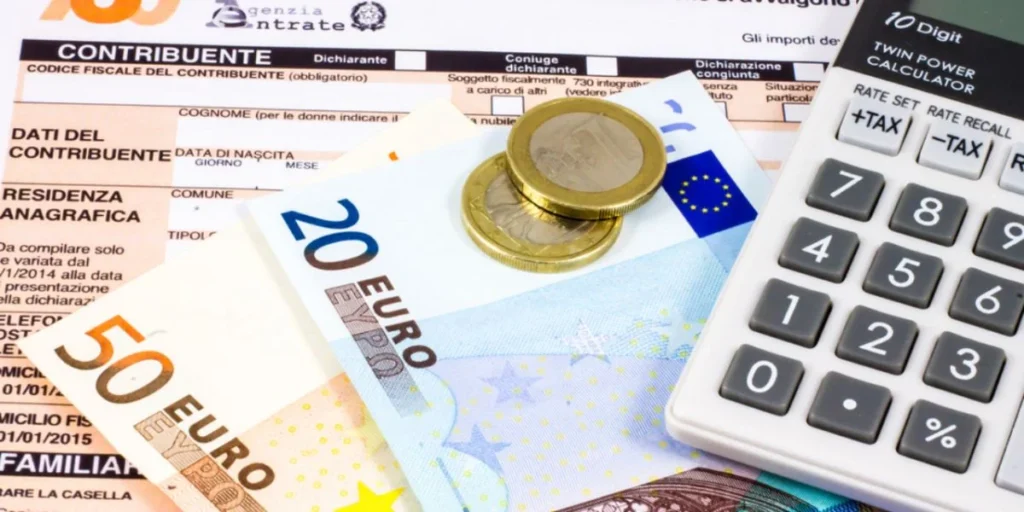
Let’s compare three realistic digital nomad profiles:
Scenario A: US Employee, €40,000 Salary, Regime Forfettario
| Item | Amount |
|---|---|
| Gross salary | €40,000 |
| Taxable base (78% coefficient) | €31,200 |
| Income tax (5%) | €1,560 |
| INPS (covered by US SSA, Certificate of Coverage) | €0 |
| Total tax burden | €1,560 |
| Effective rate | 3.9% |
| Take-home | €38,440 |
This is the dream scenario. It is why American remote workers are flocking to Italy.
Scenario B: Self-Employed Freelancer, €40,000 Revenue, Regime Forfettario
| Item | Amount |
|---|---|
| Gross revenue | €40,000 |
| Taxable base (78% coefficient) | €31,200 |
| Income tax (5%) | €1,560 |
| INPS (26.07% on €31,200) | €8,134 |
| Total tax burden | €9,694 |
| Effective rate | 24.2% |
| Take-home | €30,306 |
This is the reality for most non-US digital nomads. Still excellent compared to France or Germany, but nowhere near “5%.”
Scenario C: Self-Employed, €40,000 Revenue, Standard IRPEF (No Forfettario)
| Item | Amount |
|---|---|
| Gross revenue | €40,000 |
| Taxable base (78% coefficient) | €31,200 |
| Income tax (progressive, ~€8,000) | ~€8,000 |
| INPS (26.07% on €31,200) | €8,134 |
| Total tax burden | ~€16,134 |
| Effective rate | ~40.3% |
| Take-home | ~€23,866 |
This is what happens if you don’t elect a favorable regime. Don’t let this be you.
The Payment Timeline: When INPS Demands Its Money
INPS contributions are not paid monthly. They follow the Italian tax payment schedule via the Modello F24 form:
| Payment | Deadline | What It Covers |
|---|---|---|
| 1st Advance | June 30 | 40% of estimated current-year contributions |
| 2nd Advance | November 30 | 60% of estimated current-year contributions |
| Balance | June 30 (following year) | Final settlement based on actual income |
Late payment penalties: 30% of the unpaid amount. Italian tax authorities do not mess around with deadlines.
Your commercialista (Italian accountant) will handle the F24 preparation and submission. Do not attempt to do this yourself. The F24 system is arcane, the tax codes are specific, and a single error can trigger an audit.
What INPS Actually Gets You
It’s easy to resent a 26.07% contribution when you’re young and healthy. But INPS contributions are not just a tax—they’re social insurance. Here’s what you get:
- Pension credits: Each year of contributions builds toward an Italian state pension. The contributory system (introduced in 1996) calculates your pension based on accumulated capital × a transformation coefficient. At age 67, the coefficient is approximately 5.52%.
- Healthcare access: Once registered and contributing, you gain access to Italy’s Servizio Sanitario Nazionale (SSN), one of the world’s highest-rated public healthcare systems. This could eliminate your €2,000/year private health insurance requirement on permit renewal.
- Maternity/paternity benefits: Available after a qualifying period.
- Sick pay: Available after a qualifying period.
- Disability coverage: If you become unable to work.
The pension is the big one. If you spend 5 years in Italy on the digital nomad visa, you’ll have 5 years of Italian pension credits. If you later return to Italy or work elsewhere in the EU, those credits may be portable under EU coordination rules. For Americans, they won’t transfer to Social Security, but they remain on record if you ever return to Italy.
The 2026 Budget Law Change Nobody Is Talking About

Buried in the 2026 Budget Law (Law No. 199/2025) is a provision that affects digital nomads directly: until December 31, 2027, Gestione Separata contributions are due on only 50% of the contributory taxable base for certain categories.
This is a massive potential reduction—effectively cutting the 26.07% rate to 13.035% on half your income. However, the exact scope and implementation details are still being clarified by INPS. As of mid-2026, this appears to apply primarily to specific collaboration arrangements and may not extend to standard self-employed professionals. Monitor INPS circulars closely, and have your commercialista confirm whether you qualify.
If this reduction applies broadly to digital nomads, it would transform Italy’s financial proposition entirely. A €40,000 earner would see their INPS bill drop from €8,134 to roughly €4,067—bringing the total effective rate down to approximately 14.1%. That would make Italy competitive with Portugal’s post-NHR regime and potentially cheaper than Spain’s Beckham Law for mid-level earners.
Practical Strategies to Minimize Your INPS Burden
1. Elect the Regime Forfettario Immediately
Do not pass Go. Do not collect €200. The moment you register your Partita IVA, elect the Forfettario. Missing the election window locks you into standard IRPEF for the year.
2. Time Your Move Strategically
If you’re moving in Q4, consider whether you can delay your tax residency start to January 1. A partial year with low income may trigger the minimum contribution trap (€4,903) without corresponding revenue.
3. Keep Revenue Under the €85,000 Cap
The Forfettario ceiling is €85,000 gross revenue. If you approach it, consider deferring invoices or shifting clients to the next tax year. Crossing the threshold forces you into standard IRPEF + full VAT compliance, a compliance nightmare.
4. Explore the Impatriati Regime If You’re High-Income and Committed
If you earn €60,000+ and plan to stay 4+ years, the Impatriati regime’s 50% income exemption (which also halves your INPS base) may outweigh the Forfettario’s 5% rate. Run the numbers with a commercialista.
5. US Citizens: Get Your Certificate of Coverage
If you’re American and employed, this is the single most valuable document you can obtain. Apply through the SSA before you move. It exempts you from INPS for up to 5 years.
6. Negotiate the 4% Rivalsa with Italian Clients
If you pick up any Italian clients (remember: your primary income must remain foreign, but up to 20% can be Italian), add the 4% rivalsa to their invoices. It’s standard practice and shifts part of your INPS burden to them.
7. Monitor the 50% Base Reduction
The 2026 Budget Law’s 50% contributory base reduction could be a game-changer. Have your commercialista check whether digital nomads qualify under the latest INPS guidance.
The Bottom Line: Is Italy Still Worth It?
Let’s be brutally honest. For a US employee with a Certificate of Coverage, Italy is a financial paradise. A 3.9% effective tax rate on €40,000 is unbeatable anywhere in Europe.
For a non-US self-employed freelancer, the math is still favorable but not miraculous. A 24.2% total burden on €40,000 compares well against:
- France: ~38% effective rate for self-employed
- Germany: ~42% effective rate
- UK: ~28% effective rate
- Spain: ~24% under Beckham Law (but only for high earners, and requires specific conditions)
Italy’s advantage is that the Forfettario is available to all new self-employed workers, not just high earners or specific professions. The €28,000 income threshold is the lowest in Europe. And the quality of life—healthcare, food, culture, climate, cost of living outside major cities, is genuinely exceptional.
But you must go in with eyes open. The “5% tax” headline is technically true for income tax only. The real cost is 24–25% for most self-employed nomads. Plan for it. Budget for it. And don’t let anyone tell you otherwise.
The Checklist: What to Do Before You Move
- Confirm your tax regime (Forfettario vs. Impatriati) with a commercialista
- Calculate your projected INPS contributions based on expected revenue
- US citizens: Apply for Certificate of Coverage from SSA
- Non-US citizens: Confirm no totalization agreement exists (spoiler: there isn’t one)
- Budget for the €4,903 minimum INPS contribution in your first partial year
- Set up F24 payment schedule with your commercialista
- Register for Partita IVA within 30 days of starting work
- Enroll in Gestione Separata simultaneously with Partita IVA registration
- Monitor INPS Circular No. 8/2026 and subsequent updates for the 50% base reduction
Frequently Asked Questions
Do I pay INPS on my gross revenue or net profit?
Neither. Under the Regime Forfettario, you pay INPS on your deemed taxable base, gross revenue multiplied by your ATECO profitability coefficient (typically 78% for professional services). Under standard IRPEF, you pay on actual net profit after deducting expenses.
Can I deduct INPS contributions from my income tax?
Yes. INPS contributions are tax-deductible, which reduces your taxable base for income tax purposes. This is already factored into the calculations above.
What happens if I don’t pay INPS?
Your residence permit can be revoked. Italian law explicitly states that failure to comply with tax and social security obligations is grounds for withdrawal of the digital nomad visa.
Do I get Italian healthcare once I pay INPS?
Eventually, yes. Once you’re registered with INPS and contributing, you can enroll in the Servizio Sanitario Nazionale (SSN). However, you still need private health insurance for your initial visa application and may need to maintain it until your SSN registration is complete.
Can I avoid INPS by staying under 183 days in Italy?
Technically, if you’re not an Italian tax resident (under 183 days, no registered domicile, no center of vital interests), you’re not subject to Italian income tax or INPS. But then you don’t qualify for the digital nomad visa renewal, and you’re in a legal gray area. The visa is designed for people who actually live in Italy.
What if my income is below €18,808?
You’ll still owe INPS contributions calculated on the minimum threshold of €18,808, approximately €4,903 at the 26.07% rate. This is the price of maintaining your pension credits.